


Our Business
Reconciliation Action Plan: April 2026 to October 2027
The purpose of the Entity is to support the operations of the Courts and the NNTT, mainly through the provision of shared corporate and registry services.
The Entity refers to a group of persons who hold non-judicial positions in 3 separate Courts and one NNTT. These people are:
- the CEO and Principal Registrar of the FCA, and certain officers of that Court and staff of its registries
- the CEO and Principal Registrar of the FCFCOA (Division 1), officers of that Court and the staff of its registries
- officers of the FCFCOA (Division 2) and the staff of its registries
- the Native Title Registrar (Native Title Registrar) and the staff assisting the Native Title Registrar.
The judicial officers of each Court, and the President and Members of the NNTT, are not part of the Entity.
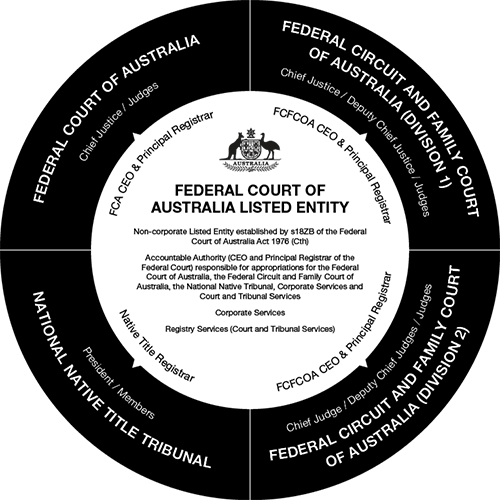
This diagram shows how the Listed Entity works with each of the Courts and NNTT.
The FCA was created by the Federal Court of Australia Act 1976 (Cth) as a superior court of record and a court of law and equity. It sits in all capital cities and elsewhere in Australia when necessary. The Court has jurisdiction in relation to almost all civil matters and a range of summary and indictable corporate criminal matters arising under Australian federal law. The Court deals with cases in relation to admiralty, bankruptcy, competition, consumer protection, corporations, defamation, human rights and anti-discrimination, industrial and employment, intellectual property, taxation and native title. It also judicially reviews a wide range of federal Government decisions in areas such as social security and immigration.
The FCA’s Native Title Practice Area is focused on First Nations led mediation and case management processes. This is aimed at promoting and facilitating the meaningful interaction between the western legal system and customary law and practices of Aboriginal and Torres Strait Islander litigants in the Court. The Court has also recently redesigned its native title mediator list to one consisting of Aboriginal and Torres Strait Islander mediators and facilitators who can be called upon to support Court processes as required.
It is frequently the case that the Court conducts mediations in remote locations. This enables matters to be discussed on the Country to which to matter relates. This practice of on country mediation also facilitates the participation of senior and other culturally appropriate people in mediation in a way which may not be possible if participants needed to travel to capital cities.
When a matter cannot be resolved through mediation, the Court frequently conducts hearings in remote locations the subject of the dispute. This allows Aboriginal and Torres Strait Islander witnesses to give evidence on-Country, supported by others from their communities, in a place where they are more comfortable talking about matters which are deeply personal and difficult to equate in a western legal system. On-Country evidence goes some way to trying to bridge the gap between traditional lore and customs and the requirements of the Native Title Act.
The Native Title Act 1993 (Cth) (NTA) established the NNTT as an independent body with a range of important functions. The NTA is, itself, a ‘special measure’ for the advancement and protection of Aboriginal and Torres Strait Islander Peoples’ rights and interests (First Nations Peoples) and the preamble clarifies its intention to advance reconciliation amongst all Australians.
The primary objectives of the NTA are:
- providing for the recognition and protection of native title;
- establishing mechanisms for determining native title claimant, non-claimant, revision and compensation applications; and
- establishing ways in which future dealings affecting native title (future acts) may validly proceed in the interests of certainty.
The NTA provides that the NNTT must carry out its functions in a fair, just, economical, informal and prompt manner.
In carrying out these functions, the NNTT will take account of the cultural and customary concerns of First Nations Peoples.
The FCFCOA comprises two separate courts under Chapter III of the Constitution: Division 1, a superior court with original and appellate jurisdiction in family law, and Division 2, a federal court with jurisdiction in family law, migration, and general federal law. Both courts were restructured under the Federal Circuit and Family Court of Australia Act 2021 (Cth), continuing the former Family Court and Federal Circuit Court as constitutionally distinct courts.
Across the Entity, we employ approximately 1,700 staff, including 38 who identify as Aboriginal and/or Torres Strait Islander peoples — 23 in the FCFCOA, 8 in the NNTT, and 7 in the FCA. Our workforce is distributed across 23 locations nationwide, spanning all capital cities and numerous regional areas. Additionally, some staff regularly circuit to and work in other rural and regional communities, further extending our reach across Australia.




