


Australian Legal Education: Still Serving the Needs of the Legal Profession?*
The 2026 Macrossan Lecture, Banco Court of the Supreme Court, Brisbane
Introduction
1. The content and quality of Australian legal education is diverse. Diversity is generally considered a virtue in today’s society, but I would like to suggest that, in the context of preparing those who will exercise enormous power over other people’s lives and fortunes, diversity should be at the margin. Members of the public who need recourse to a lawyer should be confident that there is a fundamental standard of legal education that has been attained by every person who is admitted to practice. Whilst it is true that graduate outcome surveys over the past decade indicate that somewhere between 30-40% of law students do not intend to practise as lawyers, in my view, that is not a reason to offer students a substandard law degree that is not fit for the purpose of practising law.
2. This evening, I intend to speak only about the academic content of law degrees. The Chief Justice of New South Wales, the Hon Andrew Bell AC, together with Justices Tony Payne and Jeremy Kirk, and Emeritus Professor Michael Quinlan, last year released a Discussion Paper on Practical Legal Training Reform.[1] I do not intend to enter that fray. Nevertheless, it is clear that disquiet has been growing amongst the profession about both the PLT component and the academic component of preparation for the practice of law.
3. In its June 2025 submission to the Legal Services Council on the proposed revisions to the Accreditation Standards for Australian Law Courses, to which I will return, the Law Council of Australia drew attention to the 2021 study conducted by the Queensland Law Society and the Centre for Professional Legal Education at Bond University.[2] That study found that only 51% of respondents considered students had foundational levels of substantive law. It is not possible to say whether that figure is any worse than in decades past.
4. The Law Council is the peak body for the Australian legal profession. Its overarching position in the submission to the Legal Services Council indicates that the Law Council’s answer to the question I have posed in the title to this lecture is “No”. The Law Council said, “There is an ambient concern within the legal profession that many law graduates in Australia do not possess sufficient threshold knowledge and skills to be regarded as ‘practice ready’.” It endorsed “a more concentrated approach focussed on the teaching of Priestley 11 subjects, centring on core skills and knowledge in graduate attributes, and ensuring the integrity of results.”
Setting the Scene
5. Let me start with some general observations.
6. There are 39 universities around the country offering primary degrees in law (by which I mean an LLB or JD). In addition, the Graduate Diploma in Legal Practice is offered through the Law Society of NSW and TOP law school also offers qualifications leading to admission. That is 41 schools for a population of 27.5 million, almost twice as many as in Canada which has a similar population.[3] Approximately 15,000 law students graduated in 2025.[4] A recent article in the Law Society Journal reported a partner of Piper Alderman saying there can be 500 applications for four or five graduate positions.[5] Unsurprisingly, there is a dearth of graduates prepared to relocate to rural and regional locations from major cities – but that is a discussion for another day.
7. Why do we have so many law schools? It is clear that there is not capacity within the legal profession to absorb the numbers of graduates. What we do know is that universities love law schools. They are cheap to run (unless teaching and assessment is done properly) and of course, attract the highest fees. In other words, law students, along with those studying commerce & economics, communications and society & culture, cross-subsidise students in every other discipline.
8. As a corollary to that observation, it is arguable that the barriers to enter law school are set too low, particularly where the vast majority of law schools offer undergraduate degrees straight out of school, unlike in Canada or the US. As we will see from the Accreditation Standards, no minimum entry requirement exists for entry into a law degree. Consequently, universities who want to enrol students in a law program have no difficulty finding students. This year, the minimum ATAR ranges from 63 to 99.5. In OP language, that equates with roughly an OP 16 to 1. For those even older, a TE range of 630 to 990. Many of you will recall that one needed a minimum of 880 to obtain a place in Arts at UQ in the early 90s.
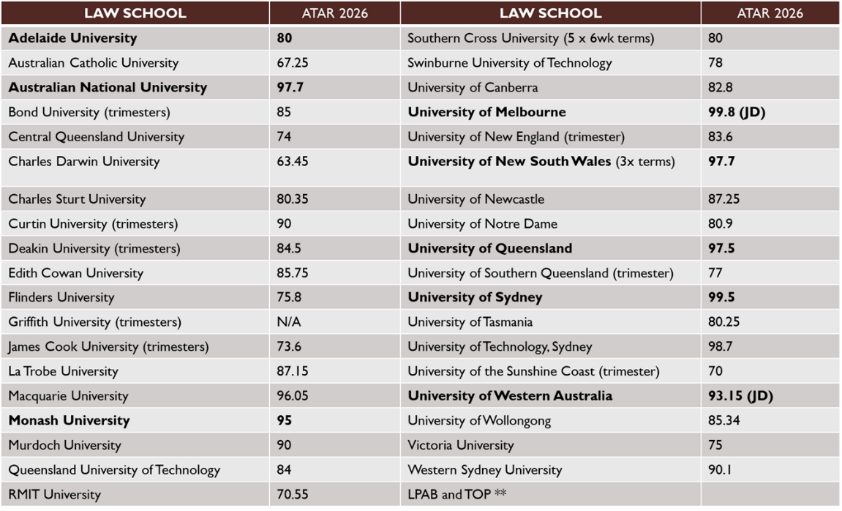
9. Law Schools have also become adept at offering courses, if not entire degree programs, online, especially since COVID. This has further removed barriers to entry for students who are unable, or unwilling, to attend a campus and engage in face-to-face learning. At one level, that is a good thing.
10. The practice of law has become truly national and so too legal education. Law students no longer necessarily attend law school in or around their hometown or city. Many are keen to study interstate, and I am aware from personal experience that many graduates wish to commence their legal careers in a State other than where they completed their law degrees.
11. Not so long ago, the practice of law was quite parochial. One was admitted to practice in a particular State or Territory, and mutual recognition of admission in one State was not assured. At my own admission in 1990, the then Solicitor General for the Commonwealth, Gavin Griffith QC, was denied absolute admission on the basis that he was not resident in Queensland. This was front page news in The Australian the following day where the comparison was, unfortunately, drawn with me, who had been unconditionally admitted, according to the paper because I just “happened to be the daughter-in-law of a Supreme Court Judge”.
12. Since that time, much has changed. As the Australian Law Reform Commission’s data hub reveals, as at 12 December 2022, the Commonwealth statute book exceeds 280,000 pages – that equates to 533 copies of Ulysses or 252 copies of War & Peace. The ALRC’s analysis shows that the average length of Commonwealth Acts increased rapidly during and after the 1980s. The increase in length and complexity can be seen most clearly in statutes that have a direct impact on individual citizens: the Health Insurance Act 1975; the Social Security Act 1991; the Migration Act 1958. The Corporations Act 2001 and associated legislation grew by 50,000 pages between 2010 and 2021. Commonwealth legislation now encroaches on many areas of law that might have once been solely State-based, for example the Environment Protection and Biodiversity Conversation Act 1999 (Cth), may be important to any number of real property transactions or commercial developments.
13. Because of the exponential increase in Federal law, it should therefore be unsurprising that the government and corporate sectors of legal practice have experienced the greatest growth – 105% and 54% respectively over the decade. By contrast, the private sector has grown only 32%. That said, two-thirds of the profession works in private practice. Of those, 78% are sole practitioners – many of whom may need to deal with Federal law in the context, for example, of family law disputes, social security issues, and migration matters. The large practices, those with 21 or more principals, account for fewer than 1% of law firms, although they employ one in five (21%) of solicitors.[6]
The Regulatory Framework
14. Let me turn briefly to the regulatory framework of the profession.
15. Despite the so-called “Legal Profession Uniform Law” applying only to NSW, Victoria and WA, the Australian legal profession is, as I have already said, a national profession. Under the auspices of the Legal Services Council, which oversees the Legal Profession Uniform Law, the Law Admissions Consultative Committee (LACC) is tasked with forging consensus on admission and admission-related matters nationally between the bodies represented by its members. The members of LACC include one person nominated by the Chief Justice of each State and Territory (Qld’s representative is Justice Tom Sullivan), a nominee of the Council of Australian Law Deans, a nominee of the Australian Professional Legal Education Community and a nominee of the Law Council of Australia. LACC reports to the Council of Chief Justices of Australia and New Zealand, which appoints the Chair: currently, Justice Francois Kunc of the Supreme Court of NSW.[7]
16. Amongst other documents, LACC has developed Accreditation Standards for Australian Law Courses, English Proficiency Guidelines, Prescribed Academic Areas of Knowledge, Statement of Duration of Law Courses, and Statement on Statutory Interpretation.
17. Each State and Territory has a Legal Practitioners Admission Board, variously described. In Queensland, it is established under the Legal Profession Act 2007. It comprises two solicitors, two barristers, one solicitor nominated by the Qld Law Society, one barrister nominated by the Bar Association (all of whom are appointed by the Chief Justice), and the Registrar of the Supreme Court, and a person nominated by the Minister. One of the Board’s functions is to approve academic qualifications. It has approved the academic qualifications of the 10 Law Schools currently offering law degrees.[8]
The Accreditation Standards
18. The Accreditation Standards for Australian Law Courses were published by LACC in July 2018. Draft Revised Standards were proposed by LACC in March 2025. The existing standards deal with, in summary:
- The nature of the law course – being a coherent sequence of unit of study leading to the award of a qualification in law provided by a self-accrediting provider or accredited by TEQSA;
- The duration of the law course – being at least the equivalent of three years’ full-time study in law;
- Learning outcomes – there must be a statement of learning outcomes for the course directed to enabling students to acquire and demonstrate appropriate understanding and competence in the prescribed areas of knowledge;
- Content of the law course – being each of the specified elements in each of the Priestley 11 and the requirements of the LACC Statement on Statutory interpretation;
- Teaching the law – each Priestley subject and any subject relating to statutory interpretation must be taught by people qualified to teach that area of knowledge, using teaching methods which enable each student to acquire the appropriate understanding and competence in each element of every prescribed area of knowledge, while providing each student with ready access to legal information resources that are sufficient in quantity and quality to enable the student to acquire the appropriate understanding and competence in each element of every prescribed area;
- Assessing understanding and competence – assessment requirements verify that a student has acquired appropriate understanding and competence in every prescribed area of knowledge and acquired the relevant knowledge and skills in the LACC Statement on Statutory Interpretation and requires a student to achieve at least a pass grade.
The Draft revisions
19. The Draft revisions to the Accreditation Standards include the following:
20. A new Standard 1 is proposed in the following terms: the law course, or one or more of the units which comprise it, may be delivered fully or partially online.
21. The Law Council of Australia submitted that it should not be possible for a student to undertake a law degree wholly online and enter legal practice.[9] I agree. The Law Council endorsed the submission made by the peak professional body in Victoria, the Law Institute, which said that “the study of law should be rooted in human interaction”.[10] It drew particular attention to the observations of Chief Justice Bell, who said in a speech in 2023:[11]
The practice of law involves many soft skills which cannot be acquired by watching a recorded lecture, posting in a discussion forum or attending a Zoom tutorial. Interpersonal skills and connections critical for full participation in the profession can be formed by participating in on-campus extra-curricular activities, socialising with peers, and having informal conversations with teaching staff before, during and after classes.
22. Neither the Law Society of Queensland nor the Legal Practitioners Admissions Board made a submission.
23. Revised Standard 1 (proposed Standard 2) does no more than makes explicit that dual degree programs are covered.
24. Revised standard 2 (proposed Standard 3) adds to the requirement that a law degree be the equivalent of three years’ full-time study, that:
Intensive or block delivery should only be used for a prescribed area of knowledge where the law school satisfies the Admitting Authority that it is appropriate in all the circumstances.
In other words, the proposed revision establishes that intensive or block delivery is only appropriate for elective courses. Some context is perhaps important. One Victorian law school teaches in four-week blocks, another in six-week blocks. Some law schools have adopted nine-week trimesters.
25. The Law Council welcomed this proposal and said “As a matter of policy, we are of the view that the Priestley subjects require a degree of depth than can only be acquired over time. The intensification of legal education … risks the student not having sufficient time to absorb and actively retain the material”.[12]
26. Revised Standard 3 (proposed Standard 4) requires learning outcomes to be directed to statutory interpretation, as well as to the other prescribed areas.
27. As to learning outcomes, in 2010 the Council of Australian Law Deans (CALD) endorsed six “Threshold Learning Outcomes” (TLOs) for the Bachelor of Laws degree. TLOs represent what a Bachelor of Laws graduate is expected “to know, understand and be able to do as a result of learning”. TLOs also exist for JD degrees. The TLOs were developed by a project group funded by the Australian Learning and Teaching Council. Relevantly, those designing the TLOs recognised that not all students pursue legal study with the purpose of seeking admission to practice.
28. The TLOs are described as the minimum outcomes expected of graduate. They are:
1. Knowledge: a graduate will demonstrate
- an understanding of a coherent body of knowledge that includes the fundamental areas of legal knowledge, the Australian legal system, and underlying principles and concepts, including international and comparative contexts,
- the broader contexts within which legal issues arise,
- the principles and values of justice and of ethical practice in lawyers’ roles.
2. Ethics and professional responsibility: a graduate will demonstrate
- an understanding of approaches to ethical decision-making,
- an ability to recognise and reflect upon, and a developing ability to respond to, ethical issues likely to arise in professional contexts,
- an ability to recognise and reflect upon the professional responsibilities of lawyers in promoting justice and in service to the community, and
- a developing ability to exercise professional judgement.
3. Thinking skills: a graduate will be able to
- identify and articulate legal issues,
- apply legal reasoning and research to generate appropriate responses to legal issues,
- engage in critical analysis and make a reasoned choice amongst alternatives, and
- think creatively in approaching legal issues and generating appropriate responses.
4. Research skills: a graduate will demonstrate
- the intellectual and practical skills needed to identify, research, evaluate and synthesise relevant factual, legal, and policy issues.
5. Communication and collaboration: a graduate will be able to
- communicate in ways that are effective, appropriate and persuasive for legal and non-legal audiences,
- collaborate effectively.
6. Self-management: a graduate will be able to
- learn and work independently,
- reflect on and assess their own capabilities and performance, and make use of feedback as appropriate, to support personal and professional development.
29. Revised Standard 4 (proposed Standard 5) adds the requirement that there be a total of at least 36 teaching hours in each prescribed area of knowledge.
30. As to the content of the law course, the basic content requirements of an accredited law degree have remained essentially unchanged since they were conceptualised by Justice Priestley in 1982. Known as the “Priestley 11”, all accredited degrees must cover the following prescribed areas of knowledge:
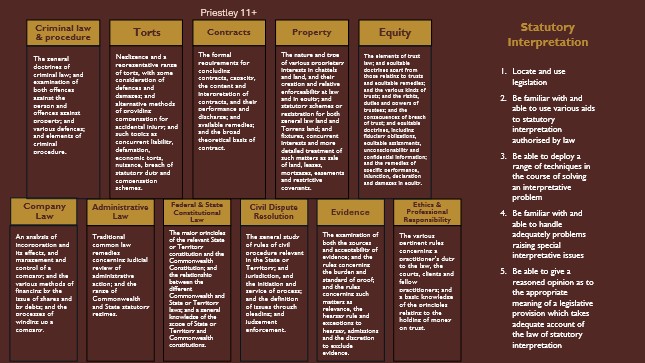
31. The above table sets out the short form description of each prescribed area of knowledge. However, the Standard in fact requires that each element of each of the prescribed areas of knowledge be taught.
32. The below table describes the elements of just two areas of prescribed knowledge: Property and Equity.
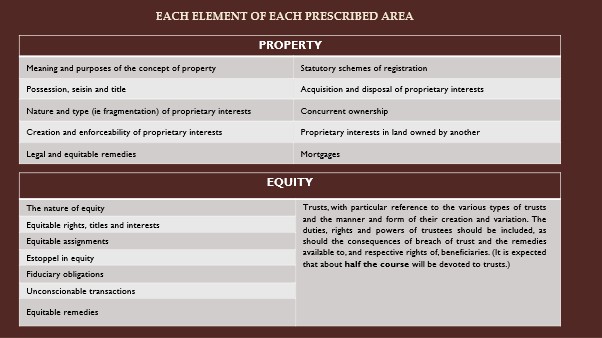
33. I venture to suggest that if Equity and Trusts are taught together in one typical 13-week semester comprised of a two-hour lecture and a one-hour tutorial (or a variation thereof), it is impossible to “teach” each element of the prescribed area of knowledge. I cannot imagine attempting to absorb the law of trusts in six weeks. It may, of course, be possible to mention each element in a reading guide or within course materials, but it beggars belief that any student could be assessed as having an appropriate understanding of and competence in the law of Equity and Trusts within that space of time, particularly if the student is taking three other courses and working in excess of 20 hours a week, as is common.
34. The only material change to the prescribed areas of knowledge has been in response to the Statement on Statutory Interpretation released by LACC in February 2010. It states five matters a law graduate should be able to do in relation to a statute:
35. Locate and make appropriate use of the text of a legislative provision in relation to a legal problem;
- Be familiar with and be able to make appropriate use of the various aids to statutory interpretation authorised by law;
- Deploy a range of techniques in the course of solving an interpretative problem;
- Be familiar with and able to handle adequately problems raising special interpretative issues; and
- Be able to give a reasoned opinion as to the appropriate meaning of a legislative provision which takes adequate account of the law of statutory interpretation.
35. In 2015, in response to the LACC Statement, CALD produced a “Good Practice Guide to Teaching Statutory Interpretation”, which recommended scaffolding students’ knowledge from first year through to final year in an iterative process. Some law schools have adopted that approach; others have a core course in statutory interpretation.
36. The proposed Standard:
- includes reference to statutory interpretation
- requires a description of a law school’s teaching methods having regard to the delivery modes for each area of prescribed knowledge and indicating the predominant method and mode
- requires total teaching hours for each prescribed area of knowledge to equate to at least 36 hours (ie: three hours per week over a standard 12-week semester).
37. Reverting to the concerns expressed by the Law Council about the lack of concentration on the Priestley subjects, even with such a revised standard, it remains acceptable under the Standard to teach each of the prescribed areas of knowledge in 36 hours. And many do.
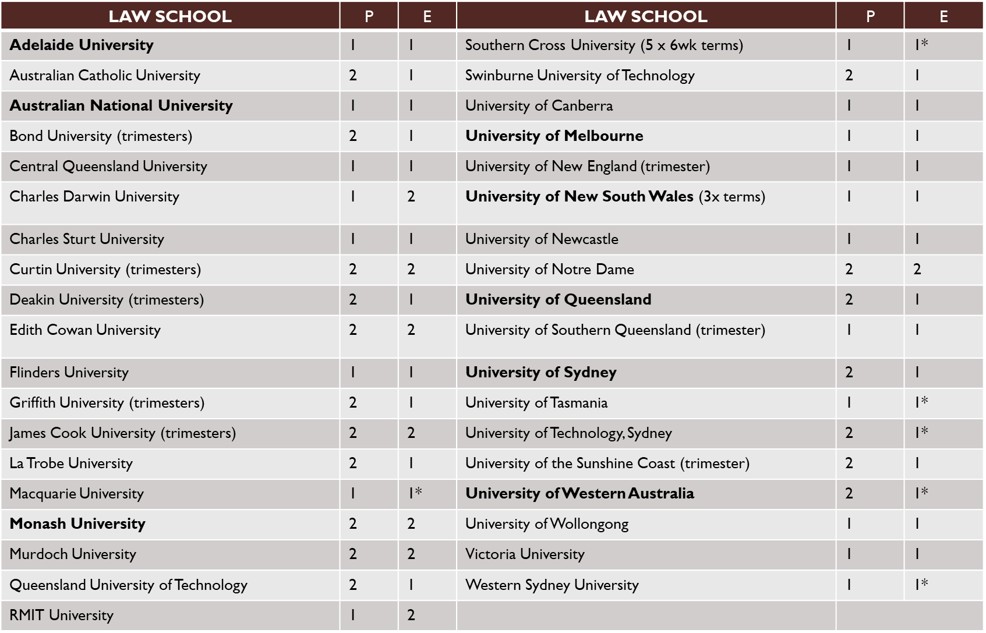
Information sourced from each Law School’s website (February 2026)
* Denotes additional compulsory course in Remedies or equivalent
38. Without wishing to hearken back to olden days too much, it is nonetheless instructive to look at what those of us who graduated in the early 90s from the University of Queensland were required to study.
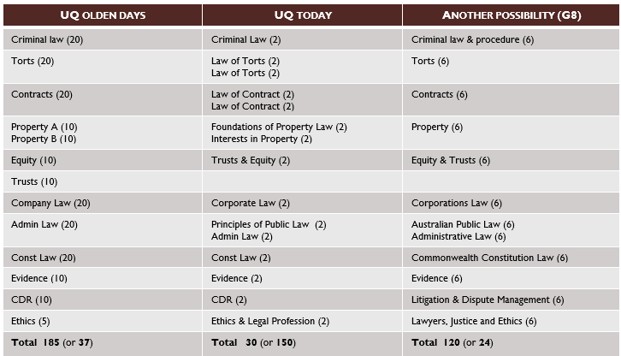
* The 3-digit number is the old credit point value where one semester-long subject was worth 10cp and a year-long subject 20 cp
* The numbers 37, 30 and 24 represent unit value as currently understood at UQ where a semester-long course is worth 2 units.
39. The table shows there has been a diminution in the time spent on teaching Priestley courses at the University of Queensland over time and that at least one other equivalent university devotes even less time to the Priestley courses. Is this necessarily a bad thing? Perhaps not. As I have already said, apart from the addition of Statutory Interpretation, the prescribed areas of knowledge have remained unchanged since 1982 and have long been the subject of academic criticism. In a chapter entitled “Hacking the Priestleys”, published in 2022, Professors Kate Galloway, Melissa Castan, and Alex Steel, reported on a project of a collective “reimagination of the core law curriculum” by a group of legal academics.[13] One table produced by this group was of the “Incidence of desirable graduate competencies”. I have reproduced it here:[14]
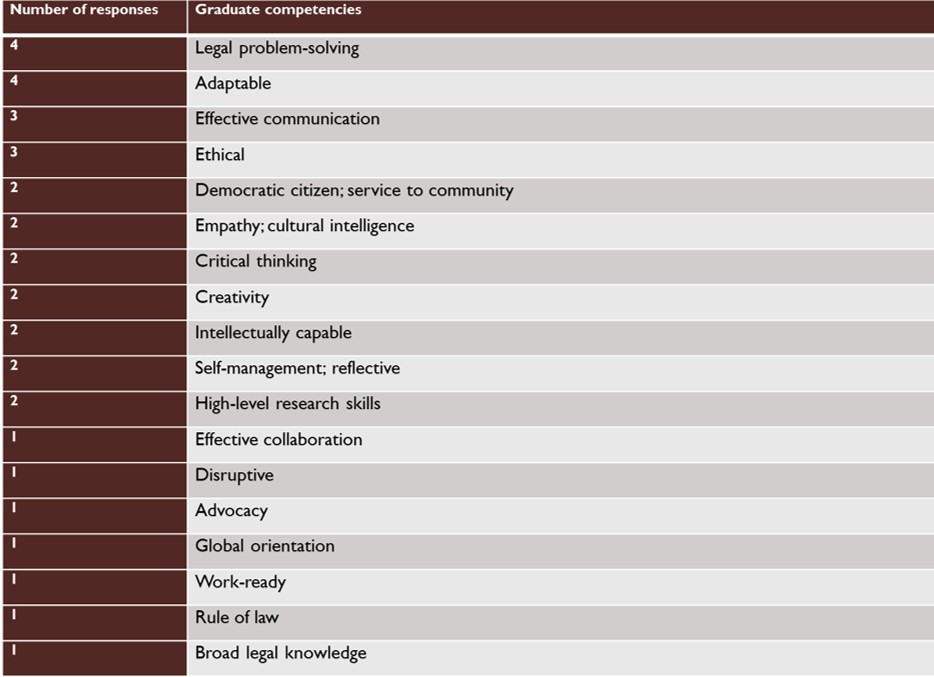
40. I note the relative value given by the group to “broad legal knowledge” and the “rule of law”. The authors explain that when the group came to nominating curriculum topics, only one of the seven groups nominated the Priestley 11 as relevant to their curriculum. It was posited that this suggests the Priestley 11 might not be prescribed but could become “optional” subjects. What otherwise seems to have become lost in this very interesting exercise is the extent to which law schools are to be held responsible for developing the broader skills necessary to practice successfully as compared with the role of the profession in nurturing young lawyers.
41. As the Taskforce on the Canadian Common Law degree said in its Final Report in 2009 at 28:
It is not reasonable to expect that law schools will graduate students who are fully capable of providing competent professional services to clients in all matters, Clearly, the profession must continue to play a role in bridging the gap between law school and formal licensing of lawyers. However, through the professional legal education students receive in law school, they should acquire foundational competencies necessary for the practice of law.
42. Nevertheless, the authors of “Hacking the Priestley” also reported on a suggestion by some participants in the project to “reframe the Priestleys” – for example, by introducing subjects called “Public and Private Law,”, “Transactions”, “Business”, and “Dispute resolution”.[15] In other words, what was really being proposed by some at least was a reorganisation of “doctrine” thematically.
43. Such a reorganisation could be extremely valuable. It would remove the siloing of content and enable students to grapple with legal problems that do not fit neatly into the paradigm of, for example, 4 weeks of content relating to vitiating factors in contract law. This is, after all, one of the great virtues of mooting.
44. There is, of course, in theory, nothing to prevent law schools from so doing now should they wish. Melbourne Law School, for example, has gone someway down this track with its course in “Obligations” in which it explores four categories of private law obligations. In practice, it is a much more difficult exercise, requiring innovative thought, careful sequencing of material, cooperation amongst academics with expertise in different doctrinal areas, and, I venture to suggest, time for students to draw together the strands of different areas of law and differing remedial responses before being assessed. And by time, I mean longer than 5 or 6 weeks for the first piece of summative assessment followed by another assessment 6 weeks later. The drive to offer students maximum flexibility in their university studies has, I fear, come at the expense of deep learning. Year-long subjects have almost vanished.
45. The authors of “Hacking the Priestleys” acknowledged that, “The extent to which expertise can be developed in providing advice to clients, acting ethically or thinking critically is likely to be limited by the degree of granularity with which a law student understands legal doctrine and the accepted rules for its manipulation”. They nevertheless suggested that “doctrine should be seen only as knowledge” and that “By letting go of doctrine as an organising category of the law curriculum, students can instead learn to independently access and interpret doctrine”. Thus, the “Priestleys would … move from a prescriptive role in degree accreditation, back to illustration only”.[16] In my view, this is akin to asking primary school children to engage in self-directed learning.
46. Revised Standard 5 (proposed Standard 6)
47. The existing standard requires that teachers in the program either: have a degree one level higher than that of the course in which the person teaches (so at least an LLM for anyone teaching in an LLB program and a PhD for anyone teaching in a JD program); or equivalent experience in practice or teaching; or the person’s teaching is guided and overseen by staff who do meet one of the previous two criteria. It also requires that the program of instruction is primarily face-to-face and involves direct interaction between teacher and student.
48. The staff profiles of each law school vary enormously. Many of the smaller schools have as few as 8 full-time staff members, with perhaps only one or two with PhDs. This means that much of the teaching must either be being done by casual or sessional staff, whose qualifications are not available publicly at least, and/or by academic staff who are not necessarily equipped to do so.
49. That must mean that, regardless of what accreditation documents indicate is being taught in a prescribed area of knowledge, there is likely to be a vast difference in the educational experience, and resultant depth of understanding, of students at one university who are being taught in nearly every prescribed area by a legal scholar in that subject, as compared with those at another university which is unable to offer teaching by leading scholars for whatever reason.
50. The revision to the standard requires at least 18 hours of either or both of “active learning” and “instruction and learning involving direct interaction between the teacher and student, whether in-person or through synchronous on-line learning”. As Professor Alex Steele from the University of NSW has explained, as drafted, a law school could satisfy the Standard by merely setting a problem question or posing a few questions at the end of a lecture.[17]
51. Pursuant to the Revised Standard 6 (proposed Standard 7), in addition:
- to providing evidence that it requires and students are made aware that all elements of each prescribed area of knowledge and all instruction in statutory interpretation are assessable
- to providing evidence that its methods of assessment confirm that a student has obtained an appropriate understand and competence in each prescribed area
- to providing evidence that its methods of assessment confirm that a student has achieved all the outcomes specified in the Statement on Statutory Interpretation
- if grade descriptors for a prescribed area of knowledge, setting out the descriptor for a pass grade
- to explaining the process it uses to satisfy itself that grades awarded accurately reflect the level of student attainment,
a law school will be required to provide evidence that at least 50% of assessments for each unit that covers a prescribed area of knowledge and statutory interpretation is conducted by invigilation.
52. The revision to the Standard appears to mean that 50% of assessment should be “supervised”, “to ensure the academic integrity of the grade.” As drafted, the Standard does not rule out the possibility of students being “supervised” whilst using computers connected to the internet to complete a particular item of assessment. All will depend on the assessment criteria drafted by the particular law school.
53. Assessment varies across law schools to a great degree. The only constraint on a law school’s assessment practices will be, I venture to suggest, whatever requirements the central bureaucracy has imposed on a school. For example, it has long been thought by central bureaucracies within Australian universities that 100% exams at the end of a semester, let alone at the end of the year, are crimes against humanity and are therefore outlawed. More likely, law schools will be told that there must be multiple forms of assessment with no one piece of assessment being worth more than 50 or 60%.
54. It seems improbable from my own experience with recent graduates, and from the concerns expressed by the profession as to the deficits in the substantive knowledge of graduates that there is any meaningful oversight of this standard. It may be an extreme example, but I am personally aware of a recent graduate, with a first-class honours degree from a regional university, who professed to have not heard of the Torrens system, not been taught mortgages or liens, nor the doctrine of specific performance. In my view, something has gone horribly wrong at that law school.
What the standards do not do.
55. Three very important things seem to be missing from the standards.
No minimum admission requirement
56. Neither LACC nor the admission boards set minimum academic standards to commence a law degree, although there are minimum standards for English proficiency, which again vary amongst the law schools. Some law schools require a Legal Admission Test in addition to a sufficiently high ATAR. This is unlike entry into medicine where the vast majority of medical schools in Australia not only require a minimum ATAR (generally above 90 but typically 99 to be competitive) and a “competitive” score in the UCAT.
57. Experience and common sense suggest that the teaching of law, particularly to school-leavers, will be vastly different where the cohort has achieved above 95 as compared with teaching a cohort with less developed academic abilities and where it is necessary to cater to a wide range of academic abilities. In my view, it is time to consider establishing a base standard for entry to the first year of an undergraduate law degree. In my view, that base standard should be an ATAR of 90.
No regular revision of prescribed areas of knowledge
58. Assuming, as I do, that academic content is primarily the responsibility of law schools, coupled with the development of the core skills necessary to deploy that content (research, writing, critical thinking, introductory advocacy), it may be useful to look at what it seems the profession might need from its graduates in terms of substantive knowledge.
59. Although I only have access to NSW data, the results of the PLT Survey released in April 2025 reveal the most common areas of practice for NSW solicitors.[18]
60. In private practice:
- Conveyancing/real property (29%)
- Commercial law (29%)
- Wills and estates (28%)
- Civil litigation (24%)
- Litigation – general (20%)
61. For those in the government legal sector:
- Administrative law (38%)
- Criminal law (35%)
- Civil litigation (17%)
- Litigation – general (16%)
- Advocacy (14%)
62. For those in the corporate legal sector:
- Commercial (54%)
- Corporate (49%)
- Banking/finance (22%)
- Intellectual property (18%)
- Industrial/employment (15%)
63. The PLT Discussion Paper considered the number and nature of claims against NSW lawyers. LawCover had provided the following information in relation to 2024/5:[19]
- 426 claims
- 64. Property law (37%)/ Family law (18%)/Elder law, wills and estates (9%)/personal injury (9%)
- 65. Top causes: poor communication (37%)/not knowing the law adequately (21%)/document problems (18%)/systems problems (16%)
66. Queensland had 368 claims, the highest number being in relation to conveyancing (26%), succession (20.8%), and commercial law (19%).[20]
What other areas of knowledge might be necessary?
65. We see that the most common area of practice for those in private practice is conveyancing and real property law. Unsurprisingly then, the greatest proportion of claims against solicitors fall within that practice area. While not evidence of any causal relationship, it is at least worth observing that half of all law schools have reduced the teaching of property law to one semester. But the prescribed area of knowledge of property law does not, in any event, deal specifically with conveyancing. That topic has traditionally been taught in an elective course sometimes called Vendor and Purchaser (it is also a compulsory component of PLT programs). No law school prescribes an equivalent course within the core requirements.
66. Commercial law features next as the most common area of legal practice within the corporate legal sector and ranks second in the private sector. Five law schools prescribe commercial law within the core requirements.
67. The third largest practice area within the private sector is wills and estates. It also attracted a relatively significant proportion of claims. Two law schools require completion of succession law.
68. Family law produced the second highest number of claims. Three law schools include Family Law in the core requirements.
69. Within the corporate legal sector, Banking & Finance Law and Intellectual Property Law are significant areas of practice. One law school requires completion of three Intellectual Property subjects within its degree. Some Banking and Finance Law is often included in a Commercial Law subject, as are some elements of Intellectual Property Law.
70. Against that background, it is instructive to look at what was required by the Solicitors Board of Queensland prior to the introduction of the uniform admission rules. In addition to what we understand as the prescribed areas of knowledge, the Board required:[21]
- Statutory interpretation – usually taught in Introduction to Law or equivalent
- Succession law
- Taxation law
- Commercial Law
- Securities
- Legal Drafting
- Vendor & Purchaser
- Family Law
No moderation or benchmarking of assessment
71. The example I have given you of a first-class honours student with large gaps in legal knowledge may not have occurred if there was any meaningful attention paid to the standard of assessment across all law schools. The standards do not mandate any type of moderation as between law schools, either regionally or nationally. In the UK, for example, exam papers and marking guides are assessed by a panel of external examiners to ensure consistency in standards across law schools. That would be a good start in this country.
72. The lack of moderation has the potential to cause great inequity amongst graduates seeking their first role. It is not unreasonable to suppose that not all law schools assess with the same rigour as others. Nevertheless, when employers are faced with 500 applications for 5 positions, a first cut is likely to be done by GPA rank. If, as has become common in many law firms, candidates are assessed with the name of the law school redacted, candidates who have entered a law school with a significantly lower ATAR, and who may not have been assessed with the same rigour as other law schools, may unfairly rank other candidates who have been subjected to more rigorous assessment.
73. Candidates for admission are now admitted to practice in GPA rank order regardless of the rank of the law school from which they have graduated. So, students with Hons IIA from a law school ranked 8 in the world will be admitted after a student with Hons 1 from a law school ranked in the global range of 351-400. This was not always the case.
What then, if anything, should change?
74. I began by saying that diversity is generally considered to be a virtue. We have 40 odd law schools spread around the country comprised of academics with a diverse range of qualifications and academic specialisation and which attract diverse student bodies. If we assume that only 60-70% of students who enrol in law schools intend to practice as lawyers, then there is perhaps an argument for less emphasis on the teaching of doctrinal law in favour of the broader “skill” set proposed by academics such as Galloway et al. I do not agree with such an argument, but I am fully aware that I fall into that category of persons, impliedly criticised by Professor Nick James, who might make up “interestingly and frustratingly [the club] … [who] are often members of the judiciary … and have quite a conservative mindset”.[22]
75. Accepting therefore that I may well be on the losing side of the argument, I offer a suggestion from a less than conservative mindset.
76. I propose that we leave law schools and legal academics to decide for themselves how they teach legal doctrine, if at all. It is near impossible to obtain consensus amongst law schools as to the doctrinal content that should be taught, the manner and mode of teaching, let alone the most appropriate and authentic forms of assessment.
77. Admitting authorities should then work with the profession, through the Law Council of Australia, to craft an external, national examination that a graduate from any law school is required to pass before being admitted to practice. Such an examination should be designed to test knowledge of core legal principles that should be known by every lawyer, regardless of whether they are generalists or specialists. It could include what is currently within the prescribed areas of knowledge and also areas of knowledge often confronted in practice but which are not considered core areas of knowledge, for example, the principles of agency, or the basic principles of succession law. Students would, of course, be told which broad areas of knowledge were examinable. It would be the type of examination susceptible to multiple choice and/or short-answer questions and would therefore be relatively cheap and efficient to set and mark. No doubt AI will be able to assist with a never-ending rotation of questions such as these.




78. Were such an examination to be required pre-admission, law schools would have the opportunity to differentiate amongst themselves. Some might avowedly promote their schools as equipping students for top-tier law firms and/or the Bar; some may avowedly promote their schools as teaching legal knowledge and thinking to those who never intend to practice but see themselves in a range of law-adjacent careers. Some may set a curriculum that sets their student up for rural or regional practice or for sole practice in the suburbs. Students who wished to pursue a career in law as a legal practitioner could select which law school might best prepare them for such a career. From whichever law school a student graduated, and regardless of what class of honours was achieved at that particular law school, every student would then be faced with the same opportunity to prove they have acquired the base standard of knowledge expected by the profession of commencing lawyers. Seniority at admission would be based on rank order in the examination.
79. Such a proposal is not intended to make a law degree redundant. As I have endeavoured to convey, practising law does not depend merely on the ability to know the law. It depends also on the ability to exercise human judgment in the context of legal problems arising from human interaction. The skills and attributes necessary to develop such an ability can only be acquired through human engagement and experience, beginning with face-to-face interaction with one’s peers, teachers, and mentors at law school.
80. A national, external examination acceptable to the profession will ensure consistency of standards of education for those entering the profession, level the playing field for all graduates who seek to enter the profession and ensure that legal education can be regularly adapted to meet the needs of the profession and the expectations of the Australian public.
* The Hon Justice Sarah C Derrington AM, Judge of the Federal Court of Australia, Professor Emerita, The University of Queensland. I am grateful to my Associate, Mr Alexander Zagami, who undertook much of the data collection from the websites of each law school. The ATAR data was sourced from the Universities Admission Centre (uac.edu.au), the Tertiary Institutions Centre, WA (tisc.edu.au), or the relevant Law School’s web page and was accurate as at 20 March 2026. In accordance with Commonwealth transparency requirements, the lowest selection rank for each law school must be published and includes any adjustment factors.
[1] Chief Justice Bell et al, “Discussion Paper on PLT Reform” (Legal Profession Admission Board of New South Wales, 30 September 2025).
[2] Law Council of Australia, (Submission, Proposed revisions to the Accreditation Standards for Australian Law Courses, 26 June 2025) 2.
[3] Angela Tufvesson, “Is Australia producing too many law graduates?”, Law Society Journal (12 November 2025).
[4] Ibid.
[5] Ibid.
[6] Urbis, “2024 National Profile of Solicitors” (Solicitors Profile, 13 June 2025).
[7] legalservicescouncil.org.au.
[8] Australian Catholic University, University of Queensland, Queensland University of Technology, Griffith University, James Cook University, Bond University, University of Southern Queensland, Central Queensland University, University of the Sunshine Coast, Southern Cross University (Gold Coast campus).
[9] Law Council of Australia, (Submission, Proposed revisions to the Accreditation Standards for Australian Law Courses, 26 June 2025) 2.
[10] Law Institute Victoria, (Submission, Proposed revisions to the Accreditation Standards for Australian Law Courses, 6 June 2025) 2.
[11] The Hon Andrew Bell, Chief Justice of New South Wales, “Comparing Online Legal Education: Past, Present, and Future” Speech, Remarks for launch of Luke Nottage and Mokoto Ibuski (eds) August 2023) 24.
[12] Law Council of Australia, (Submission, Proposed revisions to the Accreditation Standards for Australian Law Courses, 26 June 2025) 4.
[13] Kate Galloway, Melissa Castan, and Alex Steel, “Hacking the Priestleys” in Helen Gibbon et al (eds), Critical Legal Education as a Subversive Activity (Routledge, 2023)
[14] Ibid, Table 4.
[15] Ibid at 18.
[16] Ibid at 20.
[17] Professor Alex Steele (Submission, Proposed revisions to the Accreditation Standards for Australian Law Courses, undated) 1.1.
[18] Chief Justice Bell et al, “Discussion Paper on PLT Reform” (Legal Profession Admission Board of New South Wales, 30 September 2025), 24-25.
[19] Ibid at 26.
[20] Queensland Law Society, Annual Report 2024-25, 27.
[21] Rules Relating to the Admission of Solicitors of the Supreme Court of Queensland (Solicitors’ Admission Rules 1968), (Queensland Government Gazette, 16 April 1968, Vol CCXXVII, No 67) pp 1513-44.
[22] Grace Ormsby in conversation with Professor Nick James, “Priestley 11 ‘not keeping up’ with reality,” Lawyers Weekly, 27 May 2019.




