


Pride in Law 9th Annual Address
Keynote address
 RTF version - 4.7 MB
I am very proud to have been invited to give this address. Thank you for inviting me.
This is a photograph of Paul Richards. Paul was a great lawyer and the most courageous person I have ever met.
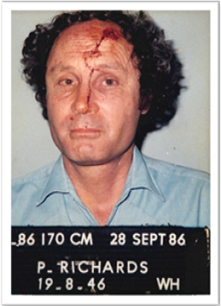
The photograph represents the foundation of my journey in the law, as I’ll explain.
I was born in South Africa. My parents did not want their children growing up under the apartheid regime and we migrated to Australia not long after the end of the White Australia policy. For those of you too young to remember, in South Africa a white minority ruled over a black majority by police and military force. The political system under which white people oppressed and discriminated against black people was called apartheid, an Afrikaans word that means separate development.
My parents were not allowed to vote. They had to carry identity cards, and if they did not have them, they could be jailed without trial. White people and non-white people by force of law had to live in different areas, went to different schools, could not intermarry and even had segregated beaches and park benches.
The apartheid system was enforced by brutal repression of any protest. Many black political leaders were imprisoned, fell out of windows or simply disappeared. Most famously, Nelson Mandela spent 27 years in prison on Robben Island.
In 1986, I was living in Canberra. I was studying economics because I had some hopelessly naïve idea that economics could save the world. But then I realised that I could only become a merchant banker or a public servant, neither of which I wanted to do.
At that time, almost every night on the television news, there were scenes of black demonstrators in South Africa being beaten with batons or shot with rubber bullets or water cannons.
In 1986, Queensland was a very different place. I think many of you will not understand just how racist and homophobic Queensland was in that era. You will have heard about endemic police corruption in Queensland in those days. What is less well known is the absolute injustice faced by Aboriginal and Torres Strait Islander people at the hands of the justice system.
On 27 September 1986, there was an Aboriginal football carnival and afterwards a dance at the RSL Hall in Baroona Road in Rosalie. The police raided the event, supposedly because of a noise complaint. There were dozens of police who arrived with police dogs and started indiscriminately beating people with their batons.
I’ll read from an article in The Courier Mail entitled Brisbane’s Dark Side published in 2020, which described what happened:[2]
There have been too many sad chapters in Queensland’s history regarding the treatment of Aboriginal people, and what happened on a warm September night in 1986 at a Brisbane RSL hall is perhaps one of the worst recent examples of how we’re really not that different to the US.
Queensland police rushed in force to the Rosalie RSL Hall where Aboriginal footballers and their families were enjoying an end of season presentation night.
Before long indigenous men, women and children were being clubbed with batons. Then the police sent the dogs in.
A senior police official shrugged off the brutality, the next day telling The Courier-Mail, “The blacks will just have to learn to behave”.
The following description of the police behaviour was given by a witness:[3]
Without warning police and police dogs began pouring in the hall. I saw about six police dogs with dog handlers ... All the police had batons in their hands. They marched into the hall and moved across it swinging their batons at the black men, women and children inside the hall. Men, women and children were being kicked and batoned even when they were down on the ground.
I saw the footage of the police brutality on the ABC News. It was just like the scenes we were seeing in South Africa. I could not believe that this was happening in Australia and that the police could not only get away with it, but be praised by the Queensland government, which was then led by Sir Joh Bjelke-Petersen. Sir Joh was the prototype of the “strong man” style of leadership now being adopted by many world leaders.
That event affected me profoundly and made me realise that if I wanted to do something about injustice, I needed to become a lawyer.
Now back to Paul Richards. Paul was never prepared to put up with injustice.
Paul had founded the Aboriginal Legal Service in Queensland in 1972, together with Wayne Goss, who went on to become the Premier of Queensland. Paul fought fearlessly to protect the legal rights of Aboriginal and Torres Strait Island people, including by regularly running trials and cross-examining police officers, who were not at all used to that happening. That made him a target for the police. The way Paul practised law required emotional, intellectual and even physical courage at times.
Paul started his own private law firm in Brisbane, Paul Richards and Associates. In fact it was directly across the road in George Street in a cockroach infested office above the Pig Inn takeaway shop. He acted predominantly for Indigenous people, but also for a trade union.
In the 1980s and 90s, Paul’s firm became a haven for Indigenous students hoping to start a career in the law. To give you an idea of his legacy, some of the Indigenous lawyers who Paul mentored include: Tony McAvoy SC, who became the first indigenous silk in Australia; Kevin Smith, now the President of the National Native Title Tribunal; Catherine Pirie, the first Torres Strait Islander Magistrate in Queensland; Jacqui Payne, the first Aboriginal Magistrate in Queensland; and Nathan Jarro, who is now a District Court judge. There were many, many others.
I want to acknowledge Terry Fisher, who is here tonight and who also worked for Paul. In fact, we shared an office across the road. We also shared some memorable legal adventures over the years. If I can be permitted to digress for a moment, one of our cases was travelling to Belfast in Northern Ireland towards the end of the Troubles to confer with our client, a man named Gerry Adams, who was the leader of the Sein Fein political party and reputedly the former leader of the Irish Republican Army. We were representing him in a case in the Federal Court of Australia. I remember his solicitor in Belfast, Rosemary Nelson, showed us a pile of death threats she’d received and saying she was really afraid for her children. Sadly, a few months later she was blown up by a car bomb. She was another example of a lawyer who practiced law with great courage.
A lesson Paul Richards drummed into all of us was the importance of maintaining our integrity as lawyers. I think we’ve all tried to live up to that. And another piece of advice he was fond of giving us was to always tuck a $20 note into our shoe before going out in the Valley. He said that way, whatever happened, we’d always have the cab fare to get home at the end of the night.
Now, to return to the dance in Rosalie, Paul Richards was there. The police recognised him, crash-tackled him from behind and smashed his head into the concrete. Then they arrested him for what used to be known as the “ham, cheese and tomato sandwich”, that is, obscene language, obstructing police and resisting arrest.
Paul was taken to the watchhouse and locked up overnight. That photograph was Paul’s mugshot taken in the watch-house.
You can see the blood trickling down his forehead. He looks absolutely miserable. But if you look closely, in his eyes you can see a look of absolute defiance. That was Paul.
For a solicitor practicing in criminal law, to be charged with criminal offences was a very serious thing. He faced the possibility of losing his practicing certificate. But he was eventually acquitted after a trial in in the Magistrates Court.
Paul then sued the police for false imprisonment and malicious prosecution. Incredibly, for those days, he won in the Magistrates Court and was awarded $6,000. Paul was really happy because he never had any money and for him, that was a huge amount.
Back in Canberra, I had heard about Paul Richards. I got in touch with Paul through a friend and said I was interested in working for him. Paul offered me articles of clerkship. Articles were a kind of apprenticeship. In those days, one way of becoming a lawyer was to do five-year articles and study part-time.
That’s how I began my journey in the law at a time when I when don’t think anyone else in Brisbane would have offered me that kind of opportunity. So, Paul changed my life and saved me from my fate as a merchant banker. Frankly, it wouldn’t have ended well for merchant banking or me.
Paul died in May this year. He had cancer and chose Voluntary Assisted Dying and died with as much courage as he had showed in his career. It was a great privilege for me to have been with him when he died. He left me the photograph in his will.
I don’t want to make Paul’s life sound sad though. It wasn’t. He was loved and respected by many, many people, particularly within the Aboriginal and Torres Strait Islander community, who have never forgotten that he was right there with them when it counted.
And two really good things happened for Paul later in life. First, he used to love Scratchie tickets and he finally hit the jackpot and won a substantial amount of money. And, second, after having been unlucky in love when he was younger, he found a wonderful partner, Shane Ambrum, and he then knew what it was to both love and be loved in return. Shane has expressed his great regret that he is unable to be here tonight.
I have said that Paul was the most courageous person I’ve ever met. But when I met him, there was one thing he was scared of.
Paul was gay. And he was scared about what would happen if it became known that he was gay. Paul was scared about losing his clients. He was scared about being ostracised in the legal community.
So for years, Paul hid the fact that he was gay. Paul was far from the only lawyer in who felt they had to conceal their sexuality. For example, I have a friend who was then working as an articled clerk in a very Catholic law firm and knew he would lose his job if it became known that he was gay.
In those days, Queensland was an overtly racist and homophobic place, particularly during my adolescence in Far North Queensland. I received my share of racist comments and insults, racist jokes and people wanting to fight me for no reason that I could understand. It left some scars. But the way I was treated was insignificant compared to the savage way in which Indigenous people were treated. Sometimes I am amazed at the incredible resilience of many Indigenous people and their capacity to, not forget, but forgive and move onwards.
When I was growing up, there was one category of people considered beneath Aboriginal people. The polite term for such people was homosexuals. I don’t think the word gay had been thought of then. I won’t mention the less polite terms that were used, although I think it is a great thing that the Queer community has reclaimed and adopted the language that was once used to demean that community, including the word “queer” itself.
I remember in high school there was one boy who was bullied relentlessly because it was thought that he was gay. It is perhaps the greatest regret of my life that I never stood up for him or offered him any support. I was just too self-absorbed as a teenager trying to keep myself out of the firing line. I wonder now how we can have been such a cruel society.
I think it must have been far worse for that boy to have been bullied for his sexuality than to be the subject of racism. If you are black, it is obvious you are black. But I can’t imagine what it must be like for a person to have to hide such a fundamental part of their own identity, such a fundamental part of who they are.
The hiding of sexuality led to an interesting phenomenon in the early 1990s, which I’m sure you know about, called outing. In the wake of the AIDS epidemic, the perceived hypocrisy of politicians, the clergy and other public figures led militant gay activists to “out” people who were or were thought to be gay.[4] It was controversial. One argument used in favour of outing was that gay and lesbian people remained invisible and only when they became visible could they push for equality. On the other hand, there was the right to privacy of people who wanted to remain in the closet, no doubt afraid of the personal consequences of being outed. A peculiar aspect of the phenomenon was outing by gay activists competing with outing by tabloid newspapers, the latter obviously not for any ideological reasons, but simply to sell copies by naming and shaming people for being gay or lesbian.
There was an interesting case I want to mention. In the 1980’s and 90’s the most popular soap opera was Neighbours. Kylie Minogue and Jason Donovan were probably the most famous people in Australia and the UK. There was speculation about whether Jason was gay, which he denied. Then a British magazine called Face published this magazine cover.[5]
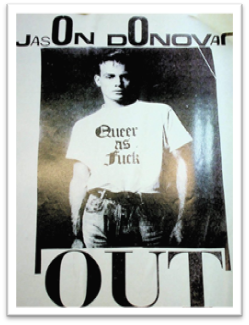
The word OUT makes it pretty clear what they were doing.
The magazine defended the case on the then novel basis that being called gay was not actually defamatory. In the end Jason Donovan won on the basis of an imputation that he was pretending not to be gay and was therefore a liar and a hypocrite.[6] He won damages of 200,000 pounds but faced a fierce backlash from the gay community.[7] He later said that suing was the worst mistake of his life.[8]
Meanwhile, back in Queensland, in 1989, there were major political and legal changes and the start of a seismic shift in societal attitudes. The Fitzgerald Report[9] brought about huge structural and cultural changes in the Queensland Police Force.
Conservative governments had been in power since 1957, but the National Party was defeated at the 1989 election. The new premier was Wayne Goss, who had started the Aboriginal Legal Service with Paul Richards years before.
There were two particular legislative changes that were important for the LGBTQIA+ community. One involved the repeal of a discriminatory law and the other was a law which prohibited discrimination on the basis of particular attributes.
The Queensland Criminal Code, under s 208, prohibited sexual intercourse between men and provided for a maximum penalty of 14 years’ imprisonment with hard labour. Section 211 prohibited what were called indecent practices between males and provided for three years’ imprisonment with hard labour. These laws were repealed in 1990.[10] Queensland was the second-last State to decriminalise sexual activity between men.[11] More recently, from 2013 to 2017, State and Territory governments began expunging historical convictions under sodomy laws so they would no longer appear on individuals’ criminal records.[12]
An article by Clive Moore and Bryan Jamison states that the last prosecutions under s 208 were of five men in Roma in 1988, and although the cases were eventually dropped, it was not before one of the men had attempted suicide.[13] The authors also note that these laws enabled and facilitated the blackmail of gay men.[14]
Another form of injustice was the selective enforcement of laws that supposedly applied equally to all people. There is not that much written about police treatment of the Queer community in Queensland, but some idea might be obtained by comparing the situation in NSW. As many as 80 gay men are thought to have been murdered between 1970 and 2010 by targeted attacks.[15] Inaction on the part of police in NSW allowed gangs to bash and murder gay men with impunity.
For example, in 2001, two men, Ross Warren and John Russell, apparently fell to their deaths in separate incidents from a cliff in Tamarama in Sydney. The police recorded that both deaths resulted from accidental falls.[16] Eventually in 2005, a Coronial Inquest was held and the Coroner reclassified the deaths as homicides, describing the original investigations as “grossly inadequate” and “shameful”.[17] The Inquest found that police were aware of gangs of teenagers that had committed the majority of these hate crimes, but little had been done to address the issue and investigations into the attacks were “inadequate and naïve”.[18]
In Queensland, Fitzgerald’s critique of the Queensland Police Force was stunning. He wrote:[19]
The Queensland Police Force is debilitated by misconduct, inefficiency, incompetence and deficient leadership…[L]ack of discipline, cynicism, disinterest, frustration, anger and low self-esteem are the result. The culture…includes contempt for the criminal justice system, distain for the law and rejection of its application to police, disregard for the truth and abuse of authority.
The enactment of the Anti-Discrimination Act 1991 (Qld) was a landmark event. Under s 6(1), one of its objects was to promote equality of opportunity for everyone, including by providing protection from unfair discrimination in areas including, work, education and accommodation. The Act prohibited discrimination on the basis of 12 attributes, including lawful sexual activity.
Since then, the protected attributes have expanded with better understanding of gender diversity and identity to now include gender identity, sexuality, and sex characteristics.
In 2023, the Criminal Code was amended to make it a circumstance of aggravation that an offender was motivated to commit offences including assault, stalking and wilful damage by hatred or serious contempt based on, relevantly, sexuality, sex characteristics or gender identity.[20]
Now there is Commonwealth legislation that also protects people from discrimination on the basis of particular attributes. For example, s 351 of the Fair Work Act 2009 (Cth) prohibits the taking of adverse action on the basis of a person’s sexual orientation, gender identity or intersex status. In 2013, new grounds were added the Sex Discrimination Act 1984 (Cth) that make it unlawful to discriminate against a person on the basis of their sexual orientation, gender identity or intersex status.
Section 124A of the Anti-Discrimination Act 1991 (Qld) prohibits a public act inciting hatred towards, serious contempt for, or severe ridicule of persons on grounds including their sexuality, sex characteristics or gender identity.
In 2008, as a member of the Queensland Anti-Discrimination Tribunal, I decided a case called Menzies & Ors v Owen.[21] Mr Owens was a gun shop owner and local government councillor in Gympie. The complaints against him included that he had a bumper sticker on his car that read, “GAY RIGHTS? UNDER GOD’S LAW THE ONLY ‘RIGHTS’ GAYS HAVE IS THE RIGHT TO DIE”. Gay people in Gympie were understandably disturbed.
In my decision, I emphasised that Mr Owen was entitled to be a homophobe and he was entitled to publicly express his homophobic views. I said that much is required in a society that values freedom of thought and expression. I also said there are limits to that freedom, and one of those limits was established by s 124A of the Anti-Discrimination Act. I found against Mr Owens, although my decision was later set aside by the Supreme Court on jurisdictional grounds.
When I approached this address, I thought there would be relatively few Australians who would think that people should not be protected from discrimination on grounds of sexuality or gender identity. I didn’t think many ordinary people would believe, for example, that it was okay for gay, lesbian or trans people to be refused employment, or refused equal treatment in their employment. I thought that might be borne out by the result of the Same Sex Marriage plebiscite which passed by a significant majority.
I knew that an exception was the controversy about employment in religious schools and institutions. Religious belief is also a protected attribute, which highlights a paradox in human rights law. The paradox is that protection of the beliefs and practices of one group of people with a protected attribute may result in discrimination against another group with a protected attribute. Finding a balance that everyone will agree upon is an unsolvable challenge.
But some of the reading I have done is eye-opening. For example, a 2011 report addressing sexual orientation and gender identity discrimination, by Catherine Branson KC, then President of the Australian Human Rights Commission, contains numerous examples of discrimination in workplaces. For example, trans and intersex people explained the unique challenges they faced in the workplace, including not being recognised as their preferred gender, being forced to disclose private information and being denied employment opportunities.[22] It was said that companies were not willing to employ trans people because they are considered too “difficult” for the workplace.[23] Examples that were reported included being referred to as a “freak” by co-workers, ongoing harassment and being demoted at work.[24]
The Law Council’s Final Report of the Justice Project in 2018 identified barriers uniquely faced by LGBTQIA+ people, including distrust of the justice system, fear of being outed and concerns about privacy and security and lack of informed and inclusive services.[25]
There are many ongoing issues. I won’t downplay them. However, I think we can say that the law and the justice system in Australia has moved a substantial way from the days of discriminating against and vilifying the LGBTQIA+ community towards offering protection from discrimination and vilification. And the legal system now has the will and the means to protect rights in cases where the evidence establishes contravention of the law. That is not to say that the Queer community is, or should be given, more favourable treatment than others, but our legal system is moving towards equal treatment.
It is important to add that judges take an oath to do equal justice to all persons and discharge the duties and responsibilities of our office according to law. It is important to emphasise that in any case, we have neither more nor less sympathy for a member of any particular group than for any other person, and are required to decide every case according to the evidence.
Having said that we are making advances in Australia, we have to remember that regression is always possible. It is not that long ago that Australia was a very different society.
I have not been able to understand the visceral hatred that seems to be directed towards transgender people from some sections of the community. If a person considers that their physical characteristics do not reflect their gender, then that is surely a matter for that person and for no one else. I have been unable to understand why transgender people should be subjected to derision, vitriol, discrimination and hatred.
There are, of course, some issues concerning transgender people that are legitimately the subject of public debate. But that debate can be conducted with respect, understanding and due consideration of the available evidence. After all, we manage to conduct civilised debates in other areas of public controversy ranging from economic issues like taxes to issues involving personal or religious beliefs like abortion laws.
People can legitimately have differing views about issues such as participation of transgender people in women’s sport, accommodation of transgender prisoners, or the capacity of children to make decisions concerning their own gender. But, why can’t those issues be discussed without vitriol, derision and hatred?
I have to say, though, that I have never quite understood what is the big issue about which toilets we use.
Australia, is by world standards, an outlier in terms of our progress towards equal treatment of LGBTQIA+ people.
There are 64 countries around the world which have laws that criminalize homosexuality.[26] In some countries, such as Brunei, Iran, Mauritania, Saudi Arabia, Yemen, Uganda and the northern states of Nigeria, people can be sentenced to the death penalty if they engage in consensual same-sex sexual acts. [27]
A number of academic and current affairs articles make a connection between attacks on democratic institutions and the erosion of protection for LGBTQIA+ rights worldwide.[28] This is particularly associated with far-right political trends.
For example, Hungary and Georgia have banned LGBTQ-related information in schools and have also enacted new restrictions on same-sex adoption and sex change.[29]
In 2023, the Russian Supreme Court declared the “international LGBT movement” an “extremist organization”.[30]
Even in countries that already restrict same-sex relationships, governments have moved to tighten existing laws. New laws criminalizing consensual same-sex acts have been introduced in the Democratic Republic of Congo, Ghana, Iraq, Kenya, and Mali.[31]
In the United States, State legislatures passed 49 new anti-LGBTQIA+ laws in 2024 alone, many of which target trans rights in particular.[32] Dozens more are pending.
There are currently a number of active cases before courts in the United States involving laws which seek to roll back the rights of the Queer community.
For example, bans on health care for transgender youths have been passed in 24 States, with 17 being challenged in State or Federal courts. There are also restrictions in accessibility and coverage of transgender medical care regardless of age, that are being challenged.
There are challenges to censorship laws which limit discussion of LGBTQIA+ identities and related topics in classrooms.
There are challenges to bans which prevent youths from participating in school sports teams that align with their gender identity.
Interestingly, just last month, the Supreme Court declined to hear an appeal against an award of damages against a former Kentucky court clerk who refused to issue marriage licenses to same-sex couples.[33] The clerk sought to overturn the decision in Obergefell v Hodges[34]in 2015 where, by a slim majority of five to four, the Supreme Court ruled that the fundamental right to marry extends to same-sex couples.
Some of the actions recently taken by the Trump administration to erode LGBTQIA+ rights include the following:[35]
- January 2025 - The Trump administration eliminated nearly all LGBTQ and HIV focused content and resources from the White House website, and from key federal agency webpages. Mentions of “lesbian,” “bisexual,” “gay,” “transgender,” “sexual orientation,” “gender identity,” and related terms are no longer accessible.
- January 2025 – An executive order was signed directing the Secretary of Defense to reinstate a ban on transgender people serving in the military.
- March 2025 - The Department of Veterans Affairs rescinded Directive 1341, a policy that for years ensured transgender, nonbinary, and intersex veterans received respectful, clinically appropriate health care.
- July 2025 – Early retirement benefits were denied for transgender members of the Air Force.
- August 2025 - The Supreme Court upheld an order from the Trump Administration, which directed national institutes to cut funding for more than 1,700 grants focusing, among other topics, on HIV/AIDS and the impact of disease on minority groups.
- October 2025 - an agency under Health and Human Services Secretary Robert F. Kennedy, announced a new goal of “stopping medical and surgical gender-affirming care for adolescents.”
- October 2025 – there were reports of FBI employees being fired for displaying Pride symbols.
- November 2025 – Supreme Court decision allowed President Trump’s administration to enforce a policy blocking transgender and nonbinary people from choosing passport markers that align with their gender identity.
These types of measures reflect the fragility of protections that were developed over a long time. For a number of these new measures, there may be room for quite legitimate debate, but for the rest, it is difficult to understand their rationale.
There are many people in this room with vastly different backgrounds and no doubt quite different political and philosophical views. But as lawyers, there is one thing that unites us all. All of us believe in justice. But what is justice? Surely, must at least mean equality and equal treatment for all under the law.
Australia is far from immune from world political trends, particularly those in the United States. Whether we will continue to make progress towards equality or whether we will regress to the way we were is yet to be seen.
But this is not the United States. I think we should trust in the essential decency of the Australian people and our belief in the equality of all under the law.
[1] I acknowledge the considerable research assistance provided by my associate, Chloe Scriggins.
[2] Grantlee Kieza, “Brisbane’s dark side: ‘The blacks will just have to learn to behave’”, The Courier Mail (online, 14 June 2020).
[3] Recorded in, ‘Batons for Blacks’ (1987) 12(2) Legal Service Bulletin 70, 76.
[4] See, for example, Randy Shilts, “Is ‘Outing’ Gays Ethical” The New York Times (12 April 1990); John Wilson, “Outing TARGET Hollywood: What…” The Los Angeles Times (22 July 1990).
[5] Published by Wagadon Ltd (1991).
[6] Alexandros Antoniou and Dimitris Akrivos, ‘Homosexuality, defamatory meaning, and reputational injury in English law’ in Diverse Voices in Tort Law (Bristol University Press, 2024) 175, 191.
[7] Ibid.
[8] Ibid.
[9] Tony Fitzgerald KC, Report of a Commission of Inquiry into Possible Illegal Activities and Associated Police Misconduct (3 July 1989) (The Fitzgerald Report).
[10] The Criminal Code and Another Amendment Act 1990 (Qld) ss 3(c), 5, 7.
[11] National Museum of Australia, ‘Defining Moments: Marriage Equality’, National Museum Australia (Web Page, 2017).
[12] Campbell Rhodes, ‘8 Hard-Won Rights for LGBTI Australians’, Museum of Australian Democracy (Web Page, 7 September 2017). See, for example, Criminal Law (Historical Homosexual Convictions Expungement) Act 2017 (Qld).
[13] Clive Moore and Byran Jamison, ‘Queensland’s Criminal Justice System and Homosexuality 1860-1954’, Queensland Review 14(2) (2007) 3, 3.
[14] Ibid, 5.
[15] New South Wales Parliament Standing Committee on Social Issues, Gay and transgender hate crimes between 1970 and 2010 (Interim Report, 26 February 2019) 13.
[16] Ibid, 9-10.
[17] Ibid, 24
[18] Ibid, 29-30, 31-33.
[19] The Fitzgerald Report, 200.
[20] Criminal Code (Serious Vilification and Hate Crimes) and Other Legislation Amendment Act 2023 (Qld).
[21] [2008] QADT 20.
[22] Australian Human Rights Commission, Addressing sexual orientation and sex and/or gender identity discrimination (Consultation Report, 2011) 9-10.
[23] Ibid, 10.
[24] Ibid.
[25] Law Council of Australia, The Justice Project (Final Report, August 2018) 23.
[26] Amnesty International, ‘LGBTI Rights’, Amnesty International (Web Page, 2025).
[27] Ibid.
[28] See, for example, Ari Shaw, ‘The Global Threat to LGBTQ Rights: The Fate of Legal Protections is Tied to the Fate of Democracy’ Foreign Affairs (online, 17 July 2025); Saskia Brechenmacher, ‘The New Global Struggle Over Gender, Rights, and Family Values’, Carnegie Endowment for International Peace (Consultation Paper, 5 June 2025); Ashifa Kassam, ‘Far right weaponising LBTQ+ rights in Europe to sow division, campaigners say’ The Guardian (online, 1 June 2025).
[29] Amnesty International, ‘Hungary: Propaganda Law has “created cloud of fear” pushing LGBTI+ community into the shadows’ (News Release, Amnesty International, 27 February 2024); Frances Mao, ‘Trans woman killed in Georgia day after anti-LGBT law passed’ BBC News (online, 20 September 2024).
[30] Human Rights Watch, ‘Russia: Supreme Court Bans “LGBT Movement” as “Extremist”’ (News Release, Human Rights Watch, 30 November 2023) [1].
[31] Brechenmacher, ‘The New Global Struggle Over Gender, Rights, and Family Values’, 6.
[32] Ibid; American Civil Liberties Union, ‘Mapping Attacks on LGBTQ Rights in U.S. State Legislatures in 2024’ ACLU (Web Page, 2025).
[33] Andrew Chung, ‘US Supreme Court rejects bid to overturn same-sex marriage right’ Reuters (online, 11 November 2025).
[34] 576 U.S. 644 (2015).
[35] GLAAD, ‘Trump Accountability Tracker on LGBTQ People: 47th Presidency’ GLAAD (Web Page, 20 November 2025).




